 Debbie Young
By Debbie Young
If you’re learning how to become a childbirth educator—or you’re an experienced instructor looking to make your classes more engaging—this post is for you.
After reading part one of this series (opens in a new tab), you now have some ideas about where to teach your childbirth classes and how to work with hospitals. But knowing where to teach is only half the battle; the other half is knowing how to teach childbirth classes in a way that keeps your students engaged, learning, and excited to return each week.
Creating Optimal Classroom Dynamics for Childbirth Learning
I still remember one of my recent classes where, at the end of the session, the guys gathered at one whiteboard while their partners worked at another. As we wrapped up, I overheard one of the men say, “What are we going to do next Tuesday? How about meeting at the brewery?” That moment made me incredibly happy. These 10 guys had bonded through the experience of preparing for fatherhood together, and they were taking that connection beyond the classroom walls. That’s a win on top of a win, and it doesn’t happen by accident.
Over my 30+ years of teaching childbirth education, I’ve learned that the difference between a class students endure and a class they truly engage with comes down to one thing: classroom dynamics. How you set up your space, interact with your students, and structure your activities can transform the learning experience from “death by PowerPoint” to something memorable and meaningful.
Recently, I reached out to several experienced childbirth education colleagues and asked them to share their best practices for interactive activities, getting partners involved, and maintaining classroom energy. Their insights, combined with what I’ve learned through decades of trial and error, form the foundation of this two-part series on classroom engagement. In this post, we’ll cover the essential foundations: setting up your space, creating welcoming first impressions, and integrating teaching strategies that keep energy high.
First Impressions: Setting Up Your Childbirth Class Space
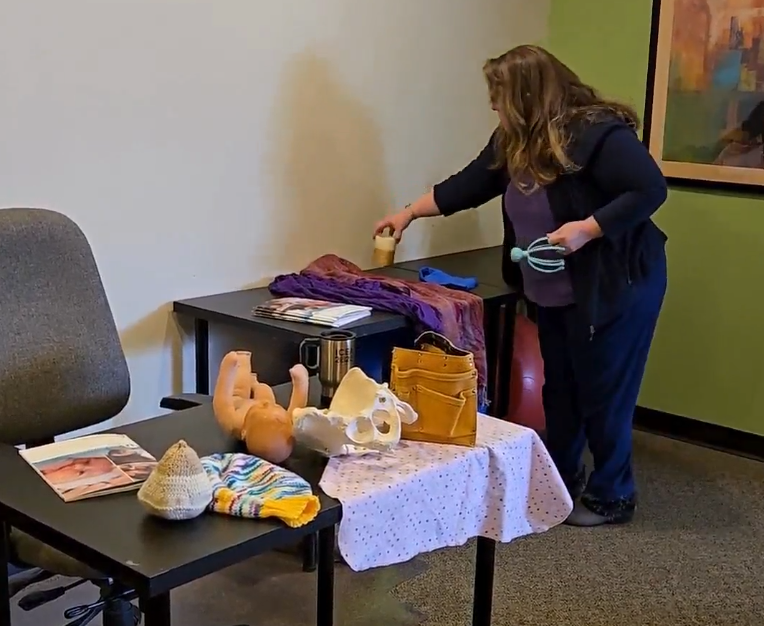
The learning experience begins before your first student walks through the door. I always arrive early, at least 30-45 minutes before class, to set up the room completely. By the time families arrive, everything should be ready.
Room setup essentials:
- All teaching tools and props are displayed and organized
- Books and handouts are laid out where students can see them
- Name placard materials are ready at each seat (more on this in a moment)
- AV equipment is tested and cued up
- Comfortable seating is arranged to encourage interaction
The Horseshoe Seating Arrangement for Childbirth Classes
I recently taught for Mary’s Hands Network in Louisiana in traditional classroom-style settings with rows of desks that we could not move, but that’s just not my style. I strongly prefer a horseshoe or U-shaped seating arrangement where everyone can see everyone else. I position myself at a small table at the open end, and all the students form the horseshoe around the room.
Why this works:
- Students can make eye contact with each other, not just stare at the back of someone’s head
- Partners feel included in the group dynamic rather than isolated
- It’s easier to facilitate small group discussions and partner work
- The setup naturally encourages participation and reduces the “lecture hall” feeling
- I can easily move around and connect with everyone
When I taught in typical classroom rows, I noticed partners were less engaged and the whole atmosphere felt more formal and less connected. The horseshoe changes everything.
Greeting Students: Setting the Welcoming Tone for Class
Every single class, I greet students at the door as they arrive. This isn’t just good manners—it’s an essential teaching strategy.
What I do:
- Make eye contact and smile genuinely
- Introduce myself personally to each person or couple
- Use their names immediately (even if I forget them later!)
- Direct them to their seats and the materials to create their own name placard
- Make small talk to help them feel comfortable: “How are you feeling today?” “Is this your first class?” “Did you find the place okay?”
This personal welcome accomplishes several things: it breaks the ice before they even sit down, it signals that this is going to be an interactive and friendly environment, and it starts building the relationship that will make them feel comfortable asking questions later.
The Name Placard Strategy: Remembering and Connecting
I’m going to be honest with you: I used to be really good at remembering names. But when you’re teaching 8-12 couples every month, with multiple cohorts running simultaneously, that skill deteriorates fast! So, I ask every student/couple to create a name placard for themselves that sits on their table or desk.
Benefits of name placards:
- I can call on people by name throughout the class
- Students can address each other by name during partner work and group discussions
- It creates a more personal, less anonymous learning environment
- It helps build that sense of community and connection between classmates
I’ve found that when students can call each other by name (“Hey Marcus, what did your group come up with?”) the classroom dynamic shifts from a collection of strangers to a cohort learning together.
Keeping Energy High: Interactive Teaching Strategies
Here’s the truth: people cannot sit and absorb information in a lecture format for 2-3 hours. They just can’t. And honestly, you shouldn’t want them to. Birth is active, physical, and unpredictable; your class should reflect that energy.
Whenever I notice energy starting to lag or eyes glaze over, I change the activity.
Activity rotation ideas:
- Shift from lecture to small group discussion
- Move from discussion to hands-on practice
- Transition from watching a video to partner work
- Go from seated learning to standing and trying positions
- Switch from full-group instruction to breakout activities
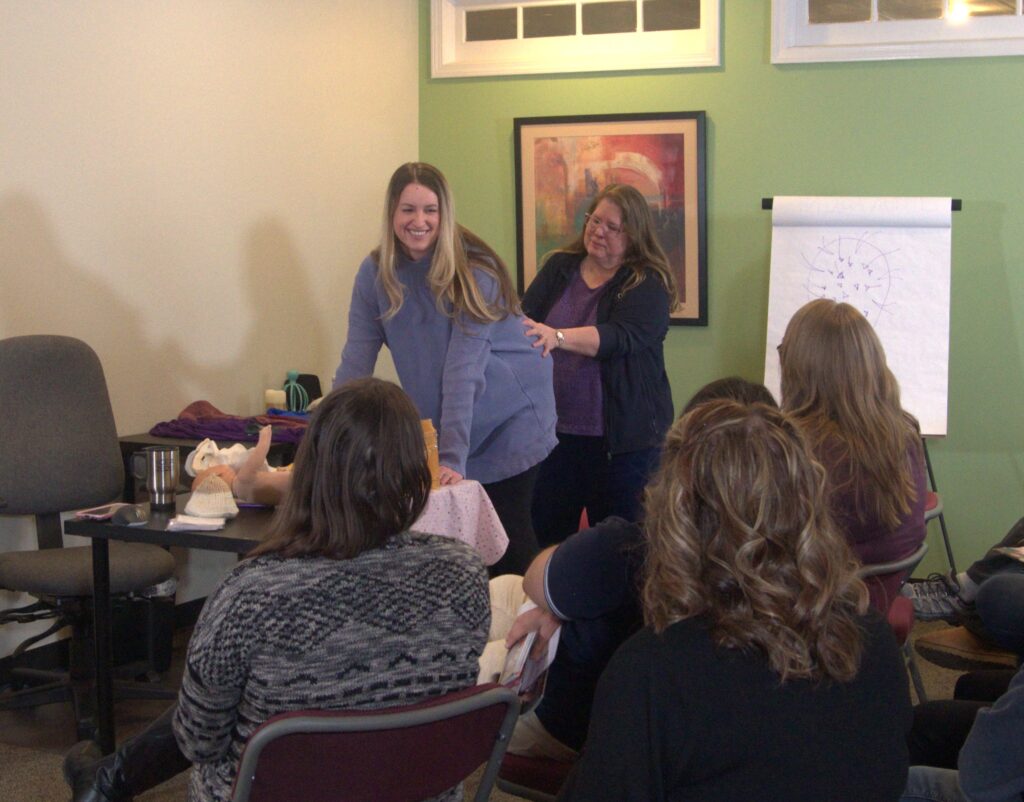
In a recent class I taught, we were covering a lot of information, and I could feel the room getting heavy. So, I had everyone get into small groups and assigned them a topic to discuss and report back on. The energy completely shifted. Suddenly there was movement, conversation, laughter, and genuine engagement with the material.
Small Group Activities: Encouraging Participation in Childbirth Class
I regularly break my class into smaller groups for activities and discussions to help keep everyone involved.
Why small groups encourage participation:
- It’s less intimidating to share thoughts with 3-4 people than with a whole class
- Quieter students are more likely to participate
- Partners can work together or separately, depending on the activity
- Students hear different perspectives from their peers
- It keeps everyone actively involved rather than passively listening
Examples of how I divide groups:
- “Partners at these two tables, work together on this question”
- “Ladies, head to that whiteboard; partners, you’re at this one”
- “Let’s count off by fours and form four groups”
- “Turn to the couple next to you and discuss this scenario”
One of my favorite activities is when I send the pregnant women to one board and the support partners to another board for separate brainstorming sessions. The partners list real times in their life that they are in pain or carrying a lot of stress and what they do about that. For instance, a hard day at work: go for a run. Slipped on the ice and twisted ankle: Use ice and Advil. On the other board, mothers list things that they might encounter in the birth process that will cause pain or stress. They don’t list a solution. We then find the solutions that the partners came up with that might fit on mom’s list to help. The idea is that they already know how to deal with pain and stress in their lives, and they can bring that knowledge into birth, too! This activity validates everyone’s concerns while also showing that they’re preparing as a team.
Engaging Support Partners: Strategies for Inclusion
If partners feel sidelined or like they’re just there to “support” without having their own role to play, they disengage. And when partners disengage, the birthing parent often gets less out of the class because they can see their support person isn’t fully present.
Strategies for engaging support partners:
Direct inclusion in discussions:
I make it a point to direct questions specifically to support partners throughout class:
- “Partners, what do you think would be most helpful during early labor?”
- “Dads and partners, when you think about being in the labor room, what concerns do you have?”
- “Support people, what’s one thing you’re excited about?”
Partner-specific content:
I dedicate time to addressing the support partner’s experience:
- What to expect emotionally during labor
- How to handle their own stress and needs
- Ways to communicate with medical staff
- Self-care during long labors
- How to support their partner after birth
Hands-on practice with partners:
This is huge. Support partners need to do things, not just watch:
- Practice massage techniques on their pregnant partner
- Try different labor positions together
- Rehearse comfort measures and counterpressure
- Learn hip squeezes and back pressure
- Practice breathing techniques together
When guys (or any support partners) are actively involved in learning, I’ve found that moms get more out of the class too. Why? Because they can see, in real time, that their partner is going to show up for them during birth. They’re learning together, struggling together, laughing together—and that builds confidence in their birth team.
Acknowledge their value explicitly:
I make sure to say out loud, multiple times throughout the course: “Your role matters. You’re not just a bystander. You are part of this birth team, and your support can make a real difference.”
Partners need to hear that. Many of them show up feeling uncertain about what they’re “allowed” to do or whether they’ll be helpful or in the way. Naming their value explicitly changes the energy they bring to the class and to the birth itself.
Creating Connection: Building a Childbirth Classroom Community
Remember that story I opened with—the guys making plans to meet at the brewery? That didn’t happen because I taught them about cervical dilation really well. It happened because the classroom environment allowed connection and community.
Ways to foster classroom community:
Facilitate peer connection:
- Encourage students to exchange contact information, if they feel comfortable
- Create small group discussions where they can relate to each other
- Share stories that normalize the range of experiences
- Celebrate commonalities: “Oh, you’re both due in June!”
Create a safe space for questions:
- Normalize all questions: “That’s a great question, I’m glad you asked”
- Never make a question seem silly or unimportant
- Invite questions throughout, not just at designated times
- Address uncomfortable topics with candor and respect
Use humor appropriately:
- Laugh with students, not at them
- Share funny moments from your own teaching or birth work
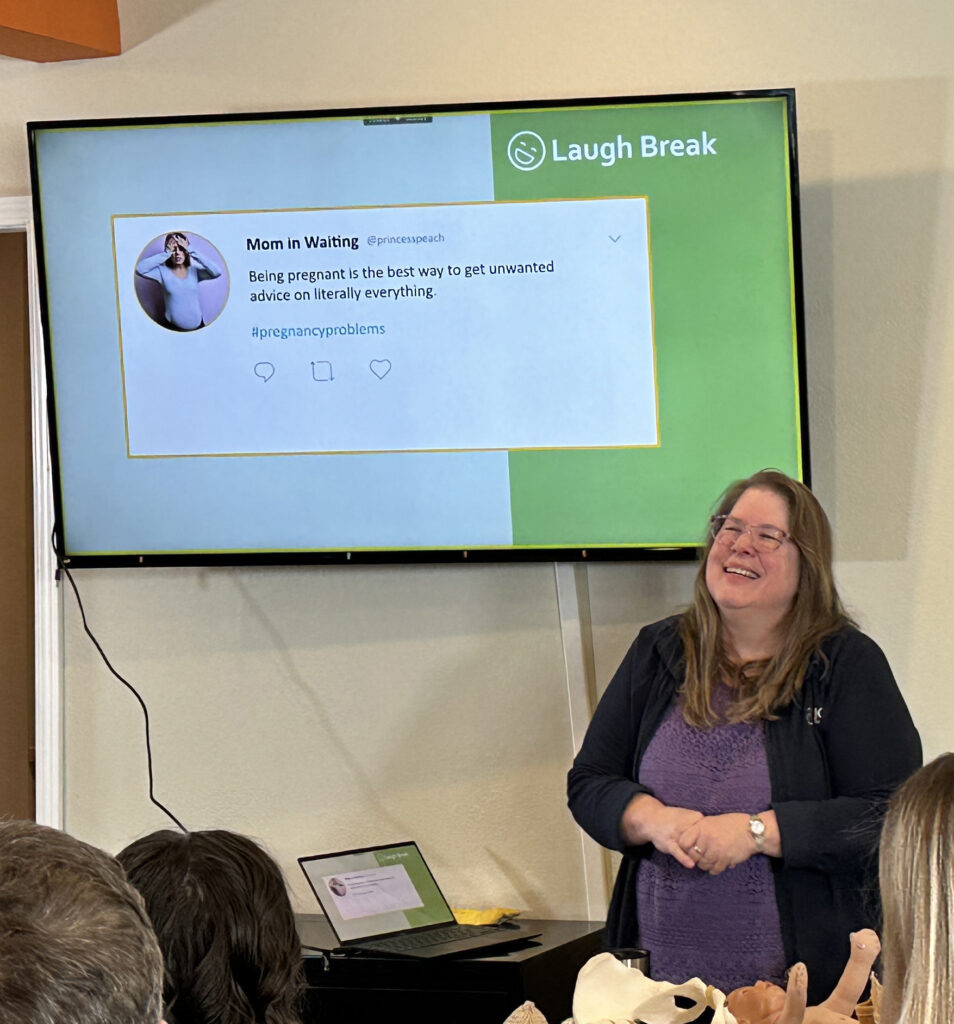
- Let natural humor happen during practice activities
- Keep it light when appropriate while honoring the seriousness of birth
Celebrate small wins:
- “You all are getting really good at hip squeezes!”
- “I love how engaged you all are tonight”
- “That was a great observation”
- Acknowledge effort and participation regularly
When students feel connected to each other and to you, they’re more invested in showing up, participating, and getting the most from the class.
Tips for New Childbirth Educators: Start Simple and Build
If you’re just starting out as a childbirth educator, don’t feel like you need to implement all of these strategies at once. These are ideas from across years, and I don’t use everyone in every class. Start with a few key practices and build from there.
Starter strategies:
- Master the horseshoe seating arrangement
- Greet every student at the door personally
- Use name placards
- Break up your lecture with a video, discussion, or partner work
- Incorporate at least one hands-on activity per session
As you get more comfortable, add more interactive elements. Experiment with different small group configurations. Try varied discussion formats. Survey your students after class to see what resonated most.
Remember: There is no perfect childbirth class, but your class may be perfect for the students you’re teaching, even if it doesn’t feel perfect to you. You’ll make mistakes (I still do after 30+ years!), but if you show up with genuine care, solid information, and a commitment to engaging your students, you’re doing important work.
What’s Next
In Part 3 of this series, we’ll dive deeper into advanced teaching techniques including using props strategically, avoiding “death by PowerPoint,” creating memorable station activities and labor rehearsals, and maintaining engagement across multi-week series. We’ll also explore insights from experienced educators and compare lecture-style versus interactive teaching approaches.
Related Resources:
Why Become Certified to Teach Perinatal Classes? (opens in a new tab)
Products Popular with Childbirth Educators:
Understanding Birth Curriculum (opens in a new tab) – Comprehensive teaching materials with interactive components
The Miracle of Birth 3: Five Birth Stories (Video) (opens in a new tab) – Engaging video content for classroom use
The Stages of Labor 3rd Edition: A Visual Guide (Video) (opens in a new tab) – Visual teaching tool for explaining labor progression
Natural Birth & Beyond On-Demand Video Library (opens in a new tab) – Affordable streaming library featuring 48 high-quality video clips and 13 printable handouts
FAQs About Teaching Childbirth Classes
How can I make my childbirth classes more engaging?
Incorporate small group work, hands-on activities, and partner practice to keep sessions dynamic and interactive.
What’s the best classroom setup for childbirth education?
A U-shaped or horseshoe arrangement encourages connection, participation, and comfort.
How do I involve partners during childbirth classes?
Ask them direct questions, provide hands-on learning opportunities, and acknowledge their essential role in the birth process.


